
Criminal Court Records in Escambia County
Escambia County criminal court records are the court case files for state criminal prosecutions. The file begins when a charge is filed in court and then grows through arraignment, motions, hearings, pleas, trial settings, verdict or plea, disposition, sentencing, probation matters, and appeals. The Circuit Clerk keeps Escambia County Circuit and District Court records, including the criminal divisions. The sheriff roster can show booking charges and bond, but the formal court record is the better source for the filed charge, plea, sentence, and final outcome.
Court level changes the record. District Criminal handles misdemeanors before sentencing and preliminary felony hearings. Circuit Criminal handles felonies before sentencing, preliminary hearings, trials, after-sentencing records, transcripts, violation of probation, and criminal appeals. The District Attorney prosecutes state criminal matters in the Twenty-First Judicial Circuit. Municipal court criminal records for city misdemeanors or ordinance violations in Atmore, Brewton, East Brewton, and Flomaton belong to those city courts, not the Circuit Clerk.
Search Escambia Criminal Records
The main online search route is Alacourt ACCESS / Just One Look. The public portal lists criminal records among the Alabama trial court record categories and supports name searches and case number searches. A paid report may include court setting dates, court actions and rulings, party details, case action summary, financial information, document images, and attachments. For a broader record type than criminal cases alone, Escambia County court records include civil, domestic, traffic, probate, and other divisions.
- Decide whether the matter is district criminal, circuit criminal, municipal, federal, or only a booking record.
- Use Alacourt ACCESS for Alabama trial court criminal case reports by name or case number.
- Check the court division and case action summary before reading a charge or disposition as final.
- Use the Escambia Circuit Clerk division phone route when the record is older, archived, certified, or unclear.
- Request certified copies with the clerk form when the document must be used for a legal purpose.
Local criminal division routing is specific. District criminal is extension 454. Circuit criminal before sentencing, preliminary hearings, and trials is extension 456. Circuit criminal after sentencing, transcripts, violation of probation, and criminal appeals is extension 466. For statewide criminal history, ALEA's Alabama background check page is the state criminal-history channel, while the court file remains the source for the case record itself.
Escambia County Criminal Case Stages
A criminal court record should be read as a sequence, not as one static entry. A charge may start the case, but later docket entries can amend, reduce, dismiss, or resolve that charge. Escambia County case files may show arraignment, preliminary hearing activity, motions, continuances, orders, plea events, trial settings, disposition, sentencing, bond, costs, restitution, probation, and violation-of-probation entries.
Case flow: Charges Filed › Arraignment › Pretrial / Motions › Plea or Trial › Disposition › Sentencing
| Stage | What Happens |
|---|---|
| Charges Filed | The complaint, information, indictment, or other charge begins the court case and identifies the alleged offense. |
| Arraignment | The defendant is advised of the charge and enters a plea. |
| Pretrial / Motions | The docket may show motions, orders, continuances, discovery activity, bond issues, and hearings. |
| Plea or Trial | The record shows whether the case resolves by plea, bench or jury trial, dismissal, transfer, or other ruling. |
| Disposition | The outcome of the charge appears, such as guilty, dismissed, not guilty, nolle prosequi, or transferred. |
| Sentencing | The case file may show jail, prison, probation, fines, costs, restitution, or other sentence terms. |
What Escambia Criminal Records Show
The criminal case record is more complete than a booking entry. It can show the defendant, charge, court, docket actions, hearings, plea, disposition, sentence, financial assessments, and later probation or appeal activity. The record can also show that a charge was amended, reduced, dismissed, no-billed, or resolved in a way that differs from the first booking entry. For a closer look at the arrest-to-charge path, use Escambia County arrest records and court charges.
| Field | What It Shows |
|---|---|
| Case Number | The court and division identifier for the criminal case. Use it exactly when asking the clerk for copies. |
| Defendant | The person charged, with party details where public and not redacted. |
| Court / Division | District Criminal, Circuit Criminal, municipal court, or another criminal venue. |
| Charges | Alabama Code citation, charge description, severity level when shown, and later changes. |
| Plea | The defendant's formal answer, such as guilty, not guilty, or other plea entry. |
| Docket Events | Hearings, motions, orders, continuances, warrants or capias entries when public, and court rulings. |
| Disposition | The outcome for the case or each charge, including dismissed, guilty, not guilty, transferred, or nolle prosequi. |
| Sentence | Jail, prison, probation, fines, costs, restitution, or other sentence terms when imposed. |
Escambia Criminal Charges vs. Convictions
Being charged in Escambia County is not the same as being convicted. A charge is an accusation filed in court. A conviction is the result of a guilty plea, guilty verdict, or other adjudication that supports a sentence. Criminal court records can show charges that were dismissed, amended, reduced, no-billed, transferred, or resolved without a conviction. That is why the disposition line is as important as the charge line.
| Charge | Conviction | |
|---|---|---|
| Stage | Accusation filed after arrest, citation, complaint, information, or indictment. | Outcome after plea, verdict, or judgment. |
| Record Clue | Charge code, offense description, filing date, bond, and pending status. | Disposition, sentencing order, probation terms, fines, costs, or restitution. |
| Risk of Misread | A booking charge may later change in court. | A conviction should be tied to the final disposition, not the first arrest entry. |
Escambia Criminal Dispositions
A disposition is the outcome of a criminal case or charge. In Escambia County criminal court records, a single case can have several charges with different outcomes. One count may be dismissed while another ends in a plea. A case can also show transferred, appealed, probation violation, or after-sentencing activity. Sentencing entries should be read with the related order, because a summary line may not show all conditions.
The sentence portion can include jail, prison, probation, court costs, fines, restitution, bond credits, and later violation-of-probation entries. A docket line may show that sentence was imposed, while the sentencing order gives exact terms. Certified copies are normally requested from the Circuit Clerk when a sentence, plea, or disposition must be used for employment licensing, immigration, expungement, appeal, or another formal purpose.
Escambia Sealed Criminal Records
Sealed and expunged criminal records are both restricted from normal public access, but they are not the same thing. Alabama court-record privacy rules restrict sealed, exempt, and confidential records unless access is allowed by law, court rule, or court order. Expungement is a statutory process filed in the criminal division of the Circuit Court in the county where the charge was filed. ALEA's expungement page states that courts grant expungements, and ALEA processes records after a valid court order.
| Sealed | Expunged | |
|---|---|---|
| Visibility | Blocked from public access by law, rule, or court order. | Removed or restricted from public access after a qualifying court order. |
| How It Happens | May occur through confidentiality law, privacy rule, or specific sealing order. | Requires a circuit-court expungement petition and eligibility under Alabama statute. |
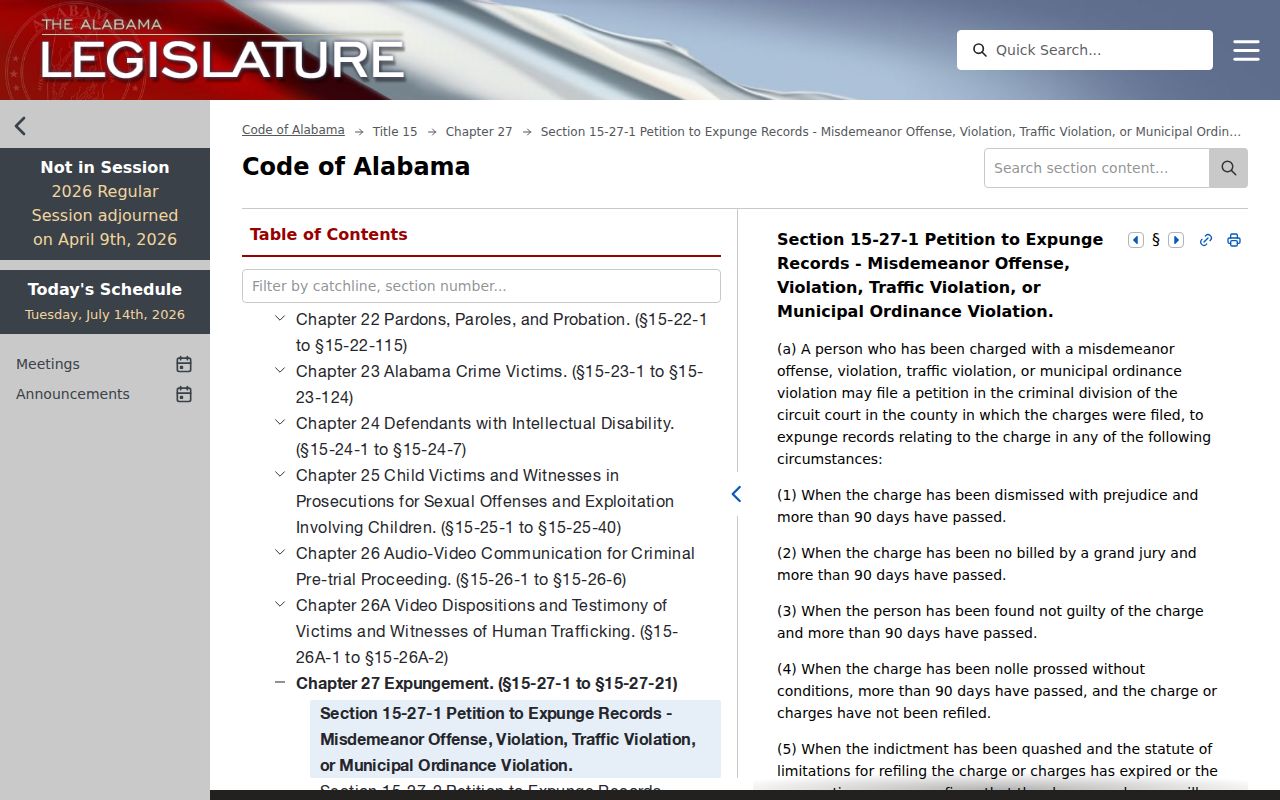
| Alabama References | Court-record privacy rules and confidential-record categories. | Ala. Code Section 15-27-1 for misdemeanor, violation, traffic, and municipal ordinance charges; Section 15-27-2 for felony charges and some convictions. |
The Alabama misdemeanor, violation, traffic, and municipal ordinance expungement statute is one required eligibility source for Escambia County criminal court records.
The Alabama felony expungement statute is the paired statute for felony charges and some conviction categories.
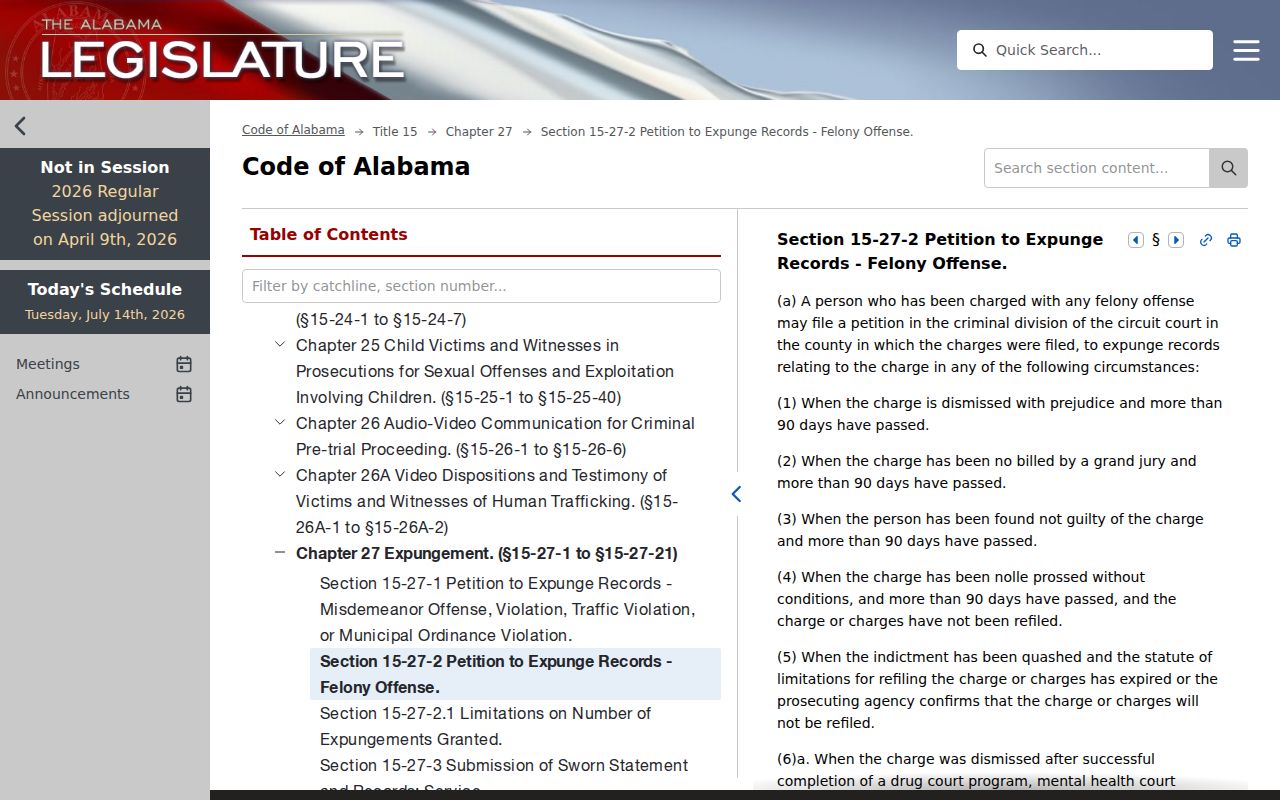
Together, those statutes show why eligibility must be checked by charge type, disposition, waiting period, and statutory limits before a petition is filed.
Escambia Criminal Access Laws
Public access to Escambia County criminal court records is grounded in Alabama public records law and court-record rules. Ala. Code Section 36-12-40 gives Alabama residents a right to inspect and copy public records unless an exception applies. Alabama Rule of Judicial Administration 30 recognizes free inspection of open court files and provides copy and search authority. Court-record privacy rules keep public access as the default but protect confidential categories.
Key Statutes:
Ala. Code Section 12-15-133 - juvenile court and related child law-enforcement records are confidential except where law allows access.
Alabama Court-Record Privacy Rules - public access is the rule, but sealed, privileged, and confidential categories are withheld.
The ALEA criminal record expungement page is the statewide agency reference for how expungement orders are handled after a court grants relief.
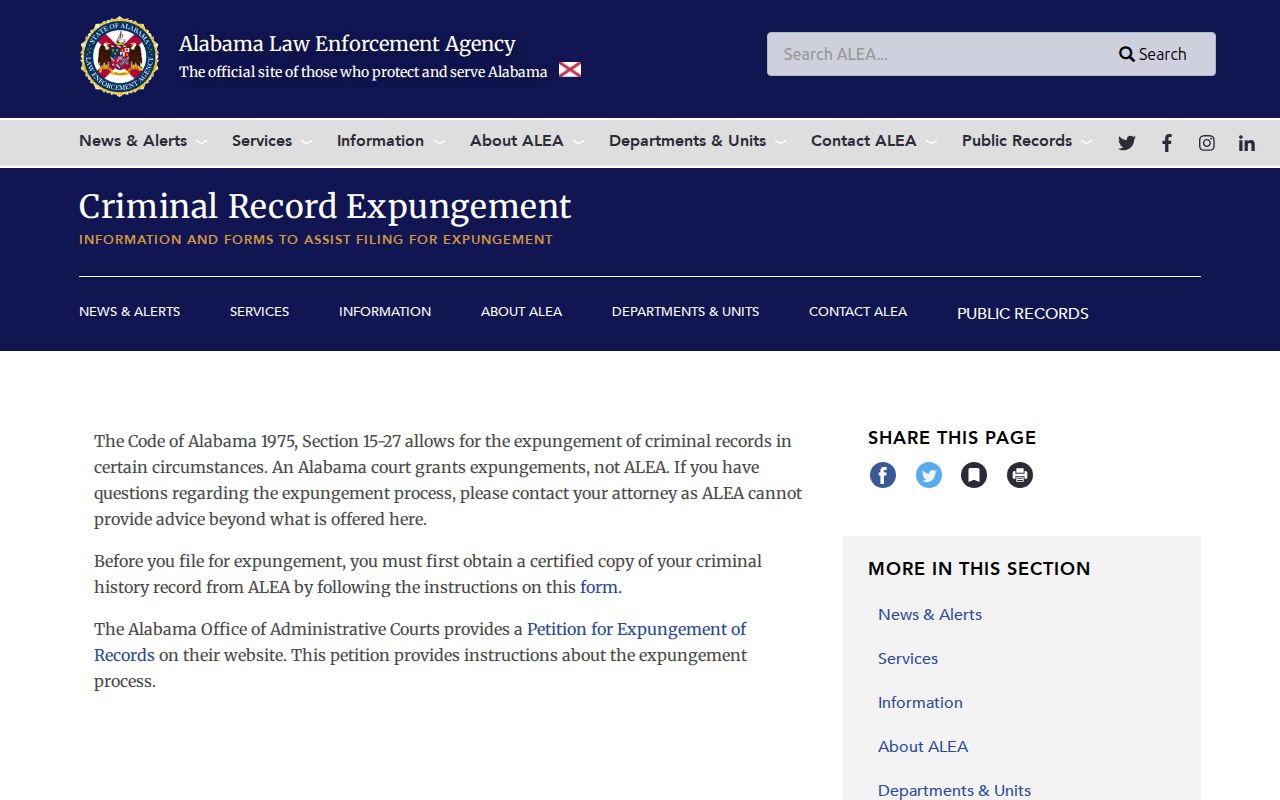
ALEA is not the court that grants expungement, which is why the Escambia County Circuit Court filing path remains central.
Escambia Criminal Background Checks
A criminal court record and a statewide criminal history are different products. The court file shows case-level actions in Escambia County's court system. A statewide criminal history may be requested through ALEA's background-check process and may include broader state criminal history information. A private employment, tenant, credit, insurance, or other FCRA-regulated screening process has separate legal rules. Casual court lookup should not be treated as a consumer report.
Important: Court lookup is not a substitute for a legally compliant background check when FCRA rules apply.
The ALEA Alabama background check page is the researched statewide source for Alabama criminal history checks.
Use that statewide route for criminal-history checks, and use the Circuit Clerk for Escambia County case documents.
Restricted Criminal Court Records in Escambia County
Restricted criminal court records include juvenile matters, sealed records, expunged records, confidential personal identifiers, and materials withheld under court-record privacy rules. Juvenile records are not routine public lookup records in Alabama. Expunged records are removed or restricted from public view after a qualifying court order. Sealed records are not released to the general public unless law, rule, or order allows it. Some mental-health, diagnostic, victim, minor, or protected personal information can also be redacted.
Indigent-defense and prosecution details may appear in a criminal docket, but they are not record-request shortcuts. The Alabama Office of Indigent Defense Services is the statewide administrative source for indigent defense, while the Escambia County District Attorney handles prosecution in state criminal cases.
For appointed counsel questions in a pending Escambia criminal case, the court or judge is the appropriate channel, not a records search.
The Alabama District Attorneys Association directory lists the District Attorney for Circuit 21 and Escambia County.
That prosecutor role explains why formal court charges may differ from the booking charge first shown by law enforcement.