
Escambia County Arrest Records and Court Charges
Escambia County arrest records document the arrest and booking side of a criminal matter. The sheriff roster can show a person already booked into the Escambia County Detention Center, with fields such as name, mugshot, booking number, booking date, arresting agency, charges, and bond. The jail page says the county jail can hold people charged and awaiting trial, people arrested on warrants, sentenced jail inmates, parole or probation holds, people awaiting state prison or community corrections placement, municipal court-sentenced inmates, and people held for other agencies.
Court charges after arrest are different. The District Attorney is the prosecutor for state criminal cases in Escambia County's Twenty-First Judicial Circuit, and that office's charging decisions can differ from the first booking entry. Once a charge is filed in District Court or Circuit Court, the charge becomes part of the court case record. The full case file and outcome belong with Escambia County criminal court records, while custody status and booking detail belong with the jail roster.
The Escambia County Sheriff's Office command staff page identifies the sheriff, chief deputy, jail warden, and command positions connected to arrest and detention operations.
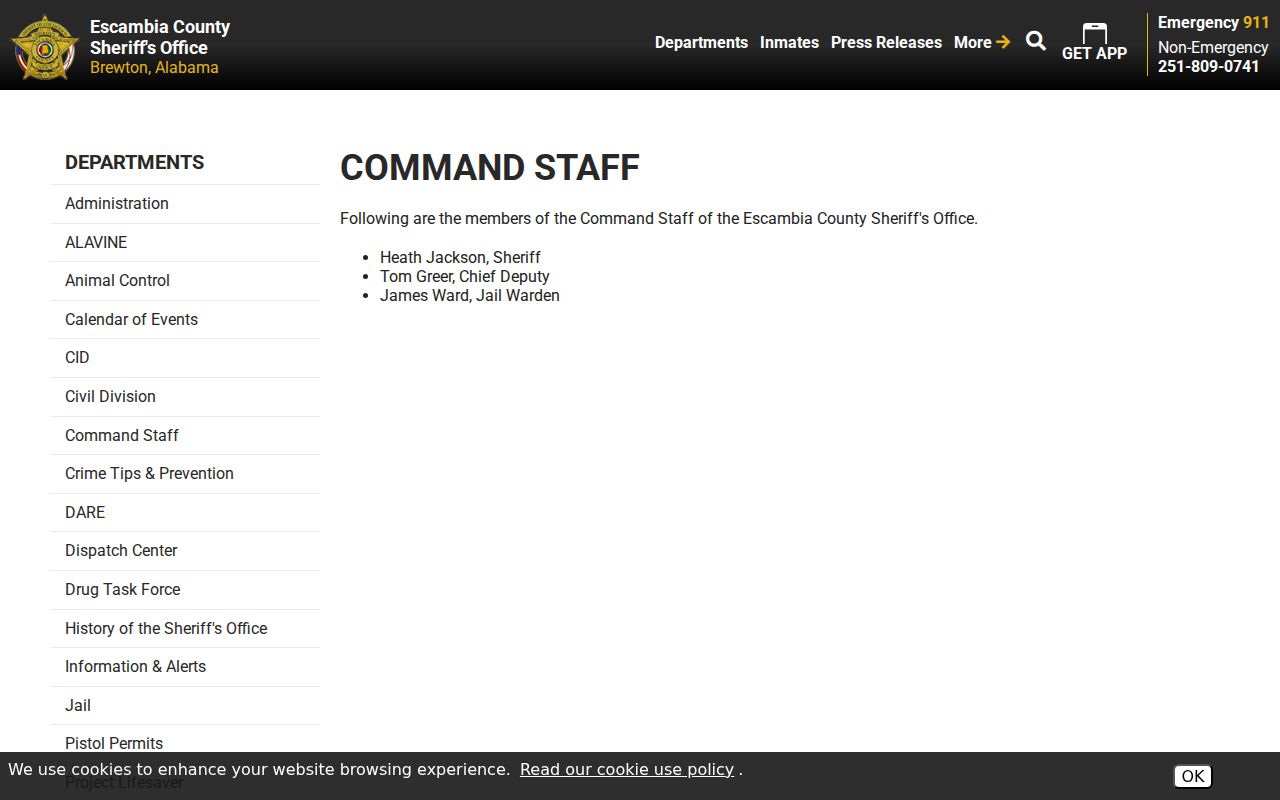
That law-enforcement source frames the booking side before the court charge record is read through the clerk and prosecutor channels.
Find Escambia Arrest Records
Use two searches, not one. For booking status after arrest, use the sheriff roster and released/48-hour roster. For the formal filed charge, use Alacourt ACCESS / Just One Look or the Escambia Circuit Clerk criminal divisions. The jail roster is not a certified court record, and the inmate profile warning says charges and bail amounts may change after court appearances. Bond companies and people wishing to post bail should call Detention Center staff for current bail, charges, and case numbers.
- Check the sheriff roster only for people already booked or released within the roster window.
- Use Alacourt ACCESS or the Circuit Clerk to find the court case and filed charge record.
- Search by defendant name if the case number is unknown, or by case number when available.
- Read each charge with its code, status, plea, disposition, and sentence instead of relying on the first booking entry.
- Call the Detention Center for current bail, current charges, and case numbers when a person is in custody.
The official jail page describes the categories of people held at the Escambia County Jail or Detention Center.
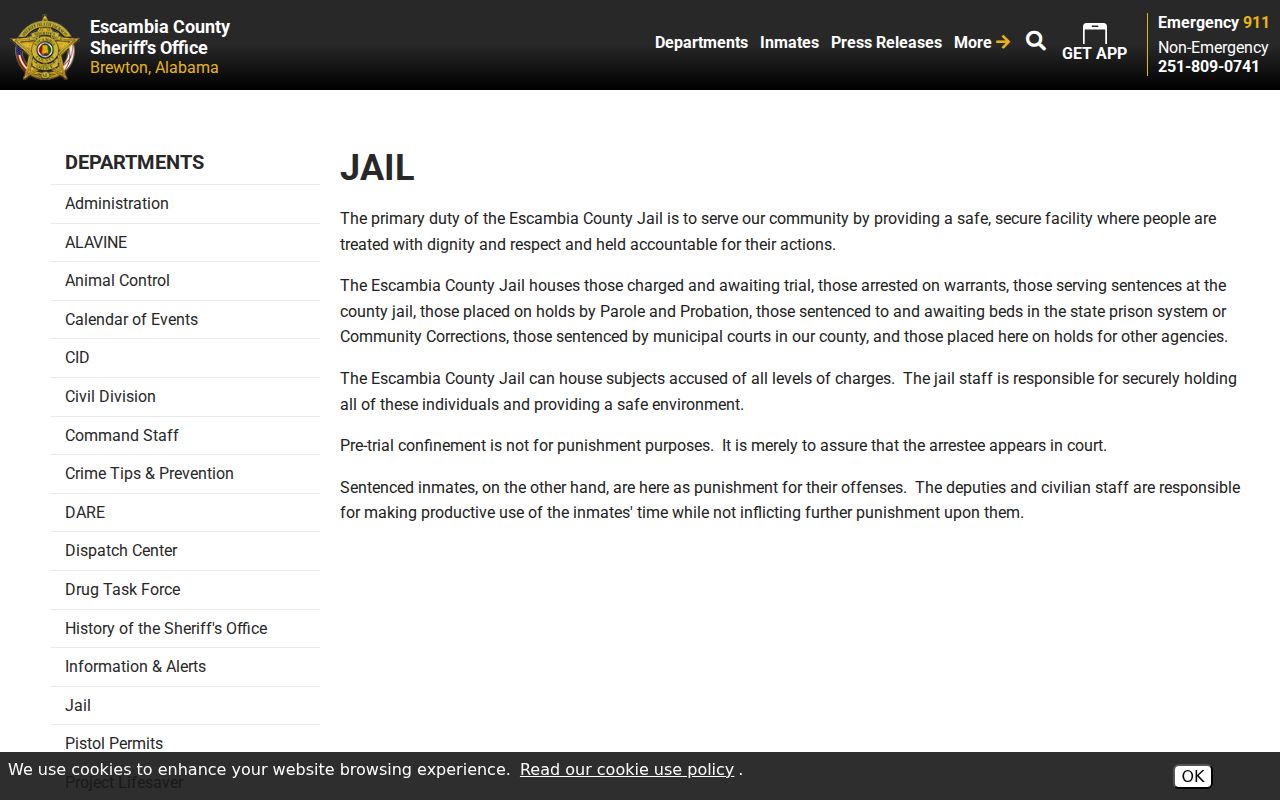
The jail's custody scope explains why a booking record may reflect pretrial charges, warrants, municipal cases, holds, or sentences.
How Charges Get Filed
An arrest can happen before the final court charge is clear. A law-enforcement agency may book a person on initial allegations, but the court charge record starts when a charging document is filed or accepted in court. In Escambia County, misdemeanor matters may proceed in District Court or municipal court depending on venue, while felony matters move through Circuit Court after filing, preliminary hearing activity, or grand jury action. The District Attorney's charging role is central for state felony and many state criminal matters.
| Complaint | Information | Indictment | |
|---|---|---|---|
| Filed By | Law enforcement or prosecutor, depending on case type and procedure. | Prosecutor. | Grand jury. |
| Common Use | Misdemeanors, traffic-related criminal matters, or initial criminal filings. | Formal prosecution route where allowed by Alabama procedure. | Felony prosecution after grand jury action. |
| Record Effect | Starts or supports the court charge record. | Defines the formal charge the prosecutor pursues. | Shows grand jury accusation and felony charge path. |
Escambia Charge Status
Charge status can change as the case moves. The sheriff profile can show the charge at booking, but the court case can later show amendment, reduction, dismissal, plea, sentence, nolle prosequi, transfer, appeal, or probation activity. This is why a booking charge should not be read as a final conviction. Each count should be checked separately when the court record lists more than one charge.
| Status | What It Means |
|---|---|
| Pending | The charge has not reached final disposition in the court record. |
| Amended / Reduced | The prosecutor or court record changed the original charge, code, count, or severity. |
| Dismissed | The charge was ended without a conviction on that count. |
| Nolle Prosequi | The prosecutor declined to continue that charge, subject to Alabama procedure and case context. |
| Disposed / Sentenced | The charge has an outcome and may include plea, judgment, fines, probation, jail, prison, costs, or restitution. |
The current inmate roster shows booking-level results with search, sorting, pagination, charges, and bond for people currently in custody.
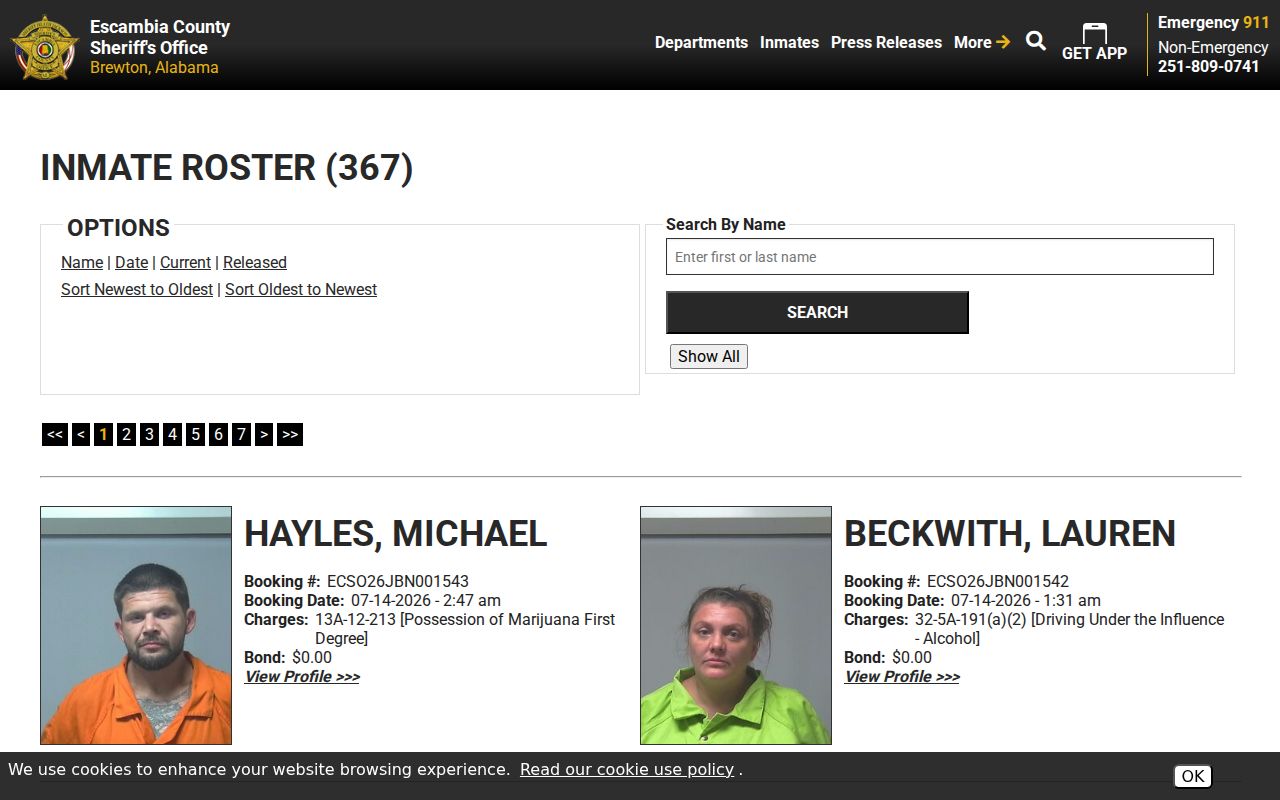
Roster data helps identify a booking, but charge status must still be checked against the court case and the detention center if bail or case numbers are current issues.
Escambia Court Charges vs. Convictions
Charges and convictions serve different roles in Escambia County arrest records and court charge records. A charge is an allegation. A conviction is an outcome after a plea, verdict, or judgment. An arrest record may show a charge before the District Attorney has finished deciding how to proceed. A court record may show that the charge was dismissed, reduced, amended, transferred, or resolved by plea or trial.
| Charge | Conviction | |
|---|---|---|
| Stage | Initial accusation or filed court count. | Final or operative outcome after plea, verdict, or judgment. |
| Where Seen | Booking roster, charging document, docket, or case action summary. | Disposition, sentencing order, judgment, or case action summary. |
| How to Read | Check for amendments, reductions, dismissals, and current status. | Read the disposition and sentence for each count. |
Escambia Sealed Charge Records
Sealed and expunged records limit public access to arrest and charge information. Alabama court-record privacy rules restrict sealed, exempt, and confidential records from general release. Expungement is filed in the criminal division of the Circuit Court in the county where the charge was filed. Alabama statutes cover qualifying misdemeanor, violation, traffic, municipal ordinance, felony, and some conviction categories, but eligibility depends on the charge, outcome, waiting period, and statutory limits.
| Sealed | Expunged | |
|---|---|---|
| Visibility | Not released to the general public unless law or court order allows access. | Removed or restricted from public view after the court grants expungement. |
| Route | Confidentiality law, court-record privacy rule, or sealing order. | Circuit Court petition in the county where the charge was filed. |
| Common Examples | Juvenile, protected personal data, sealed case material, and confidential health-related records. | Qualifying dismissed, no-billed, not-guilty, time-barred, or eligible conviction categories under Alabama law. |
Escambia Charge Codes
Escambia County charge records may list an Alabama Code section and a charge description. The inmate profile inventory reviewed in the research showed charges with code sections and bracketed descriptions, plus bond. Court records can then show whether those charges remain as filed. One arrest can produce several charges, and each charge can have its own status. Felonies generally route to Circuit Court, while misdemeanors may be in District Court or municipal court depending on the source of the charge and the court's jurisdiction.
The sample public inmate profile inspected in the research showed the visible public fields used for booking-level charge review.
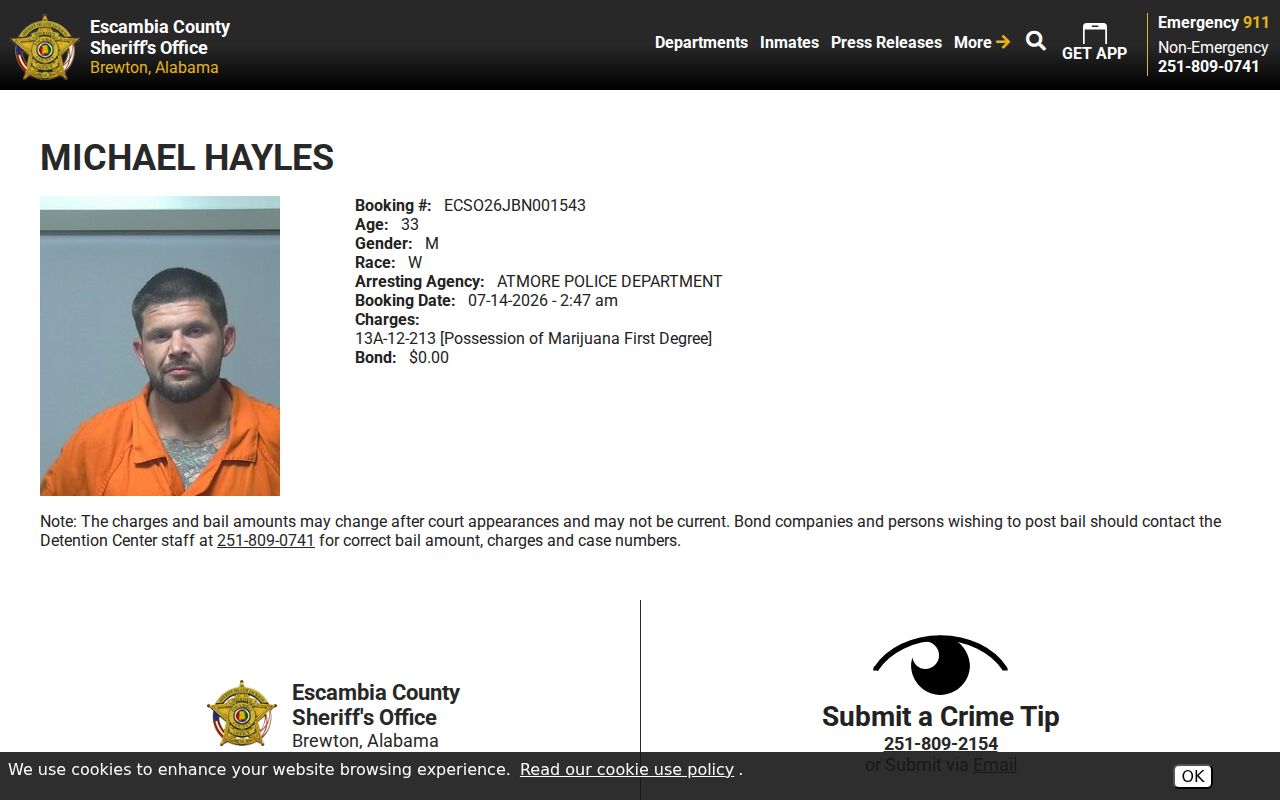
The profile warning is important: charges and bail amounts may change after court appearances, so court and detention staff confirmation may be needed.
Escambia Charge History Lookups
Statewide criminal history is not the same as a county arrest record. For Alabama criminal-history checks, use ALEA's Alabama background check page. For court charge records in Escambia County, use Alacourt ACCESS or the Circuit Clerk's criminal divisions. For custody after transfer, Alabama Department of Corrections records may apply to sentenced state inmates, and federal custody requires the federal Bureau of Prisons locator.
Warrants also affect charge searches. The research found no official Escambia County Sheriff public active-warrant lookup. Warrant questions should route to the sheriff or the court that issued the matter. Traffic failure-to-appear issues may involve Alabama traffic systems and can result in arrest warrants or license suspension. Municipal warrants may belong to Atmore, Brewton, East Brewton, or Flomaton municipal court.
Escambia Arrest Background Checks
An arrest record, booking roster, court charge record, and background check can all show different slices of information. The sheriff roster is custody and booking data. A court charge record is the filed case information. A statewide criminal-history check is a separate Alabama channel. Employment, tenant, credit, insurance, and other regulated screening uses may require FCRA-compliant procedures rather than casual lookup.
Important: Do not treat a booking charge as a conviction without reading the court disposition.
The sheriff released/48-hour roster adds recent release information for people no longer on the current custody list.
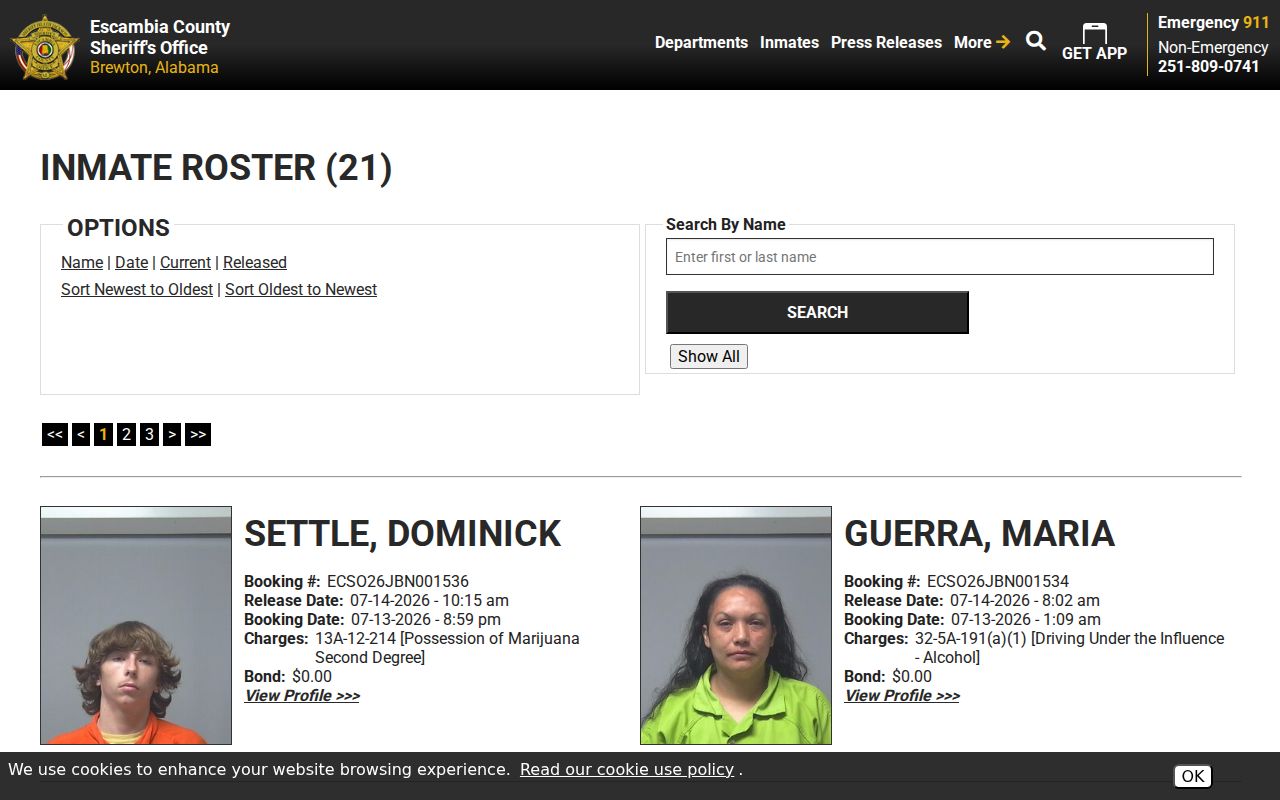
That release view supports custody research, but it does not replace the filed court charge record or final criminal case disposition.
Restricted Charge Records in Escambia County
Restricted charge records include juvenile records, sealed records, expunged records, protected personal identifiers, confidential health or mental-health material, and some ongoing or protected law-enforcement information. Alabama juvenile records are confidential except where law permits access. Expunged records are removed or restricted from public access after a valid court order. Sealed records are not released to the general public without authority. Sheriff public records requests also may not release sealed warrants, juvenile warrants, ongoing investigation material, or protected information.
The safest reading rule is simple: use the sheriff for custody status, the detention center for current bail and current charge questions, the Circuit Clerk for filed court charges and certified copies, the District Attorney for prosecution contact, and the issuing municipal court for city charges or warrants. Those channels are separate because arrest records and court charges are created by different offices at different points in the case.